#32 What If Everything You Think About "Experience-Based Hospitality" Is Actually Backwards?
This article exposes why the amenity-centered interpretation of "experience-based hospitality" is a dead end. More critically, it introduces Experience Portfolio Architecture™ not as another wellness trend, but as a structural revenue redesign that redefines what...
Tímea Pokol
3/30/20264 min read
What If Everything You Think About "Experience-Based Hospitality" Is Actually Backwards?
The hospitality industry has spent a decade chasing a ghost. For ten years, operators have been investing in yoga classes, artisanal coffee, Instagram lobbies, and curated wellness packages all while believing they were building "experience-based" hotels. They were not. They were decorating capacity-constrained, price-dependent revenue models with surface-level amenities and calling it strategy. This article exposes why the amenity-centered interpretation of "experience-based hospitality" is a dead end. More critically, it introduces Experience Portfolio Architecture™ not as another wellness trend, but as a structural revenue redesign that redefines what a hotel actually sells, who it serves, and why pricing power returns when you stop competing on amenity and start competing on relevance. This is not decoration. This is economic restructuring.
1. The Lie That The Industry Keeps Telling Itself
Walk into almost any "experience-based" hotel and ask: "What experience are you designed to deliver?"
You will get a vague answer about ambiance, storytelling, personalization, and guest journeys. You will hear about the sourdough bread and the marble bathrooms. You will hear about "authentic moments" and "memorable stays."
Then ask: "Who is this hotel structurally designed to serve, and which guest motivations do you deliberately exclude?"
You will get silence.
An "experience-based" hotel that serves everyone is not experience-based. It's a generic hotel with better PR.
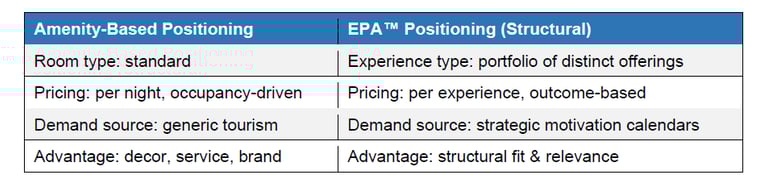
The industry has conflated two entirely different concepts: amenity elevation (making the room nicer) and structural repositioning (rebuilding the business model around specific motivations). The first is tactical. The second is strategic. Almost every hotel claiming to be "experience-based" is doing the first while pretending it's the second.
2. Why Amenities Are The Wrong Lever
Here's the economic trap that most independent hotels fall into:
You need higher rates. The market won't support higher rates for a generic room. So you invest in amenities: better linens, a spa, a culinary program, a co-working space. The amenities are real. The problem is economic.
Amenities are a cost structure that requires volume to justify. If you spend €50,000 on a wellness program, you need occupancy to be high enough that the added revenue per occupied room exceeds the amortized program cost. In low season, when occupancy drops, those amenities become dead weight fixed costs competing with erratic demand.
This forces hotels into a familiar trap: discounting.
When occupancy falls, you cannot sustain the high-amenity cost structure at premium rates. So you discount. The discount trains guests to expect discounts. Your brand equity erodes. Your pricing power evaporates. You enter a margin-death spiral.
Experience Portfolio Architecture™ breaks this logic entirely. Instead of investing in amenities to justify a higher rate, you invest in clarity about which specific travel motivation you serve. Then pricing becomes outcome-based, not comparison-based. Volume becomes secondary to relevance.
3. The Amenity Paradox: More Investment, Less Differentiation
As amenities proliferate, they become commoditized. A five-star amenity in 2010 is standard in 2020. A luxury spa in 2015 is expected in 2025. The co-working desk that differentiated you three years ago is now table stakes across 40% of the market.
This creates a structural problem:
1. You invest in amenities to stand out
2. Your competitors see the same trend and invest in the same amenities
3. All hotels converge on similar offerings
4. Differentiation disappears
5. You compete solely on price
You've spent capital and operational complexity to end up where you started—competing on the cheapest rate.
This is why amenity-based positioning fails. It's a treadmill. You run faster but end up in the same place.
Experience Portfolio Architecture™ exits the treadmill entirely. Instead of competing on "who has the nicest spa," you compete on "who serves the most relevant motivation with the most economic integrity." That's a competition nobody else is equipped to win because it requires structural clarity, not capital investment.
4. What "Structural" Actually Means
Let's define terms precisely, because this is where the transformation begins.
5. Why Pricing Power Returns
Here's the economic truth that the amenity-focused hotel industry avoids:
Pricing power does not come from having nicer things. Pricing power comes from having no credible alternative.
When a guest searches "boutique hotel in Prague with spa," they are shopping. There are competitors. Price is comparable. You lose based on reviews, price, and availability.
structural fit. They are asking: "Is this built for me?"
In the first scenario, you must discount to win. In the second, price becomes secondary to relevance.
This is not premium pricing psychology. This is structural repositioning of the entire value proposition.
6. The Portfolio Logic: One Hotel, Multiple Demand Engines
The most counterintuitive insight in Experience Portfolio Architecture™ is this:
Your hotel does not have a demand problem. Your hotel has a clarity problem.
The amenity-focused hotel assumes: "Low season = fewer tourists = lower demand = must discount." The EPA™-structured hotel assumes: "Low season = different motivations peak = different demand engines activate = pricing stays stable."
Notice: There are no truly "bad" months. There are only different demand engines. When leisure tourism drops, corporate and professional demand activates. This is demand diversification through motivation architecture.
The result: occupancy stays stable, pricing doesn't collapse, and your hotel is no longer hostage to tourism seasonality.
7. Strategic Exclusion: The Most Radical Principle
Some guests should never book your hotel even at full price.
If your hotel is designed around leadership offsites, creative retreats, and wellness transformation, then a budget tourist looking for a cheap weekend break should not book you. Even if you have empty rooms. Even if you're desperate for occupancy.
This sounds insane. But it's the foundation of everything that works. When your hotel deliberately excludes certain guests, you own the positioning. You set the terms. You control pricing.
8. The Real Question You Should Be Asking
If your hotel is "experience-based," here's the litmus test:
Can you clearly define who your hotel is NOT for, and why?
If you can't answer that question, you're not experience-based. You're amenity-based with better marketing. If you can answer it, you understand Experience Portfolio Architecture™. You understand that experiences are not add-ons to rooms. Experiences are the organizing principle of your entire business model.
"Which specific travel motivations are we structurally designed to serve, and which ones should we deliberately exclude?"
That question is where profitability stops being seasonal and starts being sustainable.






© 2026. All rights reserved.
Tímea Pokol
Tourism Recovery & Strategy Specialist
The Unlearning Module – Free Instant Access to the EPA™ Framework
Why you must unlearn everything you know about traditional tourism marketing before building a premium, high-yield experience.
Company
Contact
Terms & Conditions
Privacy Policy
MarLocker S.L.
C/Honda 1,
04450 Canjáyar
Almería
Spain
NIF: ESB22689137